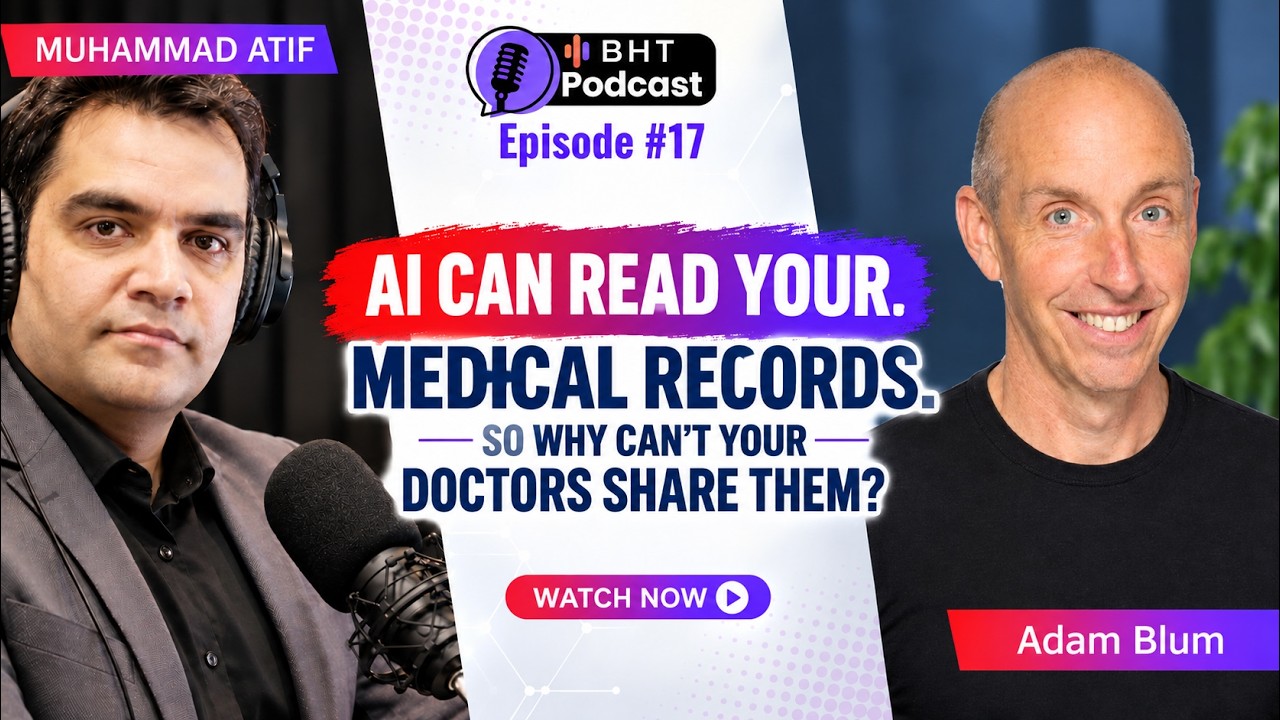
AI Can Read Your Medical Records. So Why Can’t Your Doctors Share Them?
From a cancer diagnosis that no hospital would share records for, to an open-source personal health record and precision clinical trial matching. Adam Blum on fixing the data under healthcare AI.
Guest
Adam Blum
CTO, HealthKey.AI
Host
Muhammad Atif
President & CTO, PureLogics
Runtime
44 minutes
Video and audio

Watch the full conversation
Recorded for BetterHealthTech. Also available on Spotify and wherever you listen to podcasts.
Digital doesn’t mean connected. Patients are still being asked to act like human USB drives.
Adam Blum was diagnosed with follicular lymphoma while travelling in France. Back in the UK, his private GP would not use the French records, the NHS redid every diagnostic test, and the US trial centres he contacted would not accept records from any of the three. To this day the only record he has managed to get is a single unstructured DICOM image.
That experience led him to build CancerBot, a free precision clinical trial matching service, and then to co-found HealthKey.AI, which builds PRomop, an open-source personal health record built on the OMOP data model. In this episode he and Muhammad Atif look at why earlier attempts at personal health records failed, why FHIR and the Cures Act change the picture, and why even the smartest healthcare AI is only as good as the patient data underneath it.
What the episode covers
- Why Adam’s own records were refused in France, the UK and the US
- How CancerBot cuts a weeks-long trial search down to minutes
- Why more than 90% of patients who think they qualify for a trial are turned down
- Precision eligibility versus ordinary clinical trial matching
- Why Google Health and Microsoft HealthVault failed, and why now is different
- FHIR, the Cures Act and the patient’s legal right to their own record
- PRomop: one store for the official record, analytics and care decisions
- HL7 PHR’s 748 requirements for a secure, trusted personal health record
Episode at a glance
Guest
Adam Blum
Role
CTO, HealthKey.AI
Host
Muhammad Atif, President & CTO, PureLogics
Series
BetterHealthTech
Topic
Personal health records, interoperability, clinical trial matching
Runtime
About 44 minutes
Inside the episode
Chapter markers taken from the recorded episode.
Highlights and introduction
Patients as human USB drives, and why even the smartest AI is useless without the right data.
Adam’s story
A lymphoma diagnosis in France, and four providers that would not accept each other’s records.
Why CancerBot exists
Trial eligibility is written in prose, so most patients who apply are turned down.
From three weeks to minutes
4,000 patients, no brokerage fees, and work on standards for precision matching.
Precision matching, explained
Why asking three questions and storing the patient is not real trial matching.
The personal health record
Patient data is spread across clinics, hospitals, pharmacies, surveys and wearables.
Why earlier PHRs failed
No standard pipes and no legal right to the data. FHIR and the Cures Act changed both.
Who owns the record
The patient owns it, the foundation hosts it, HealthKey only provides the software.
What a complete record unlocks
Clinical decision support, trial options and research on which treatment works best.
Where healthcare AI gets its data
Care bots and predictive models need a flat, clinically grounded record to work from.
Trust, security and the human in the loop
HL7 PHR’s 748 requirements and where AI should stop and a person should decide.
Rapid-fire round
Overhyped AI, trial matching, paper, and what patients should never have to do again.
Six things to know about patient health data
What Adam says every healthcare leader and builder should understand before putting AI on top of patient records.
Patients don’t stay in one place
A patient’s data is split across local clinics, more than one hospital, pharmacies, quality-of-life surveys and wearables. No single provider holds the full record.
The pipes finally exist
FHIR gives a standard way to move data, and the Cures Act means providers must let patients download their record electronically.
FHIR alone is not a record
A FHIR bundle is JSON you cannot easily analyse. It has to be broken apart into a structured record before it is useful for care or research.
One store instead of three
The official record, the data lake for analytics and the flat record for care decisions can live in a single OMOP-based store.
Security has a roadmap
HL7 PHR sets out 748 requirements for tamper-proofing, auditing, roles and granular sharing. Anyone building a PHR should follow it.
Precision beats guesswork
Matching on dozens of real eligibility criteria, not three questions, saves patients wasted trips and saves researchers years.
Adam Blum, on BetterHealthTech
Three things to take from this conversation
The data problem comes before the AI problem
Care bots and predictive models spend most of their effort fishing data out of medical records. Fix the record and the AI becomes far easier to build and far easier to trust.
Patients own their health record
The law already gives patients the right to download their data. The missing piece is a trusted place to bring it together, and disease foundations are best placed to host it.
Trial matching is badly underused
Only about 3% of patients worldwide get onto a clinical trial. Precision matching can get more patients to better care and move the science faster.
Adam Blum
CTO, HealthKey.AI
Adam is CTO of HealthKey.AI, which builds PRomop, an open-source personal health record that combines a patient record with the OMOP data model for analytics, care decisions and AI. HealthKey provides it as a managed service to disease foundations and health information exchanges.
After his own follicular lymphoma diagnosis, Adam built CancerBot, a free precision clinical trial matching service now part of HealthKey with around 4,000 patients. He also works with an IEEE group setting standards for precision trial matching.
Muhammad Atif
President & CTO, PureLogics
Atif hosts BetterHealthTech, where he talks to the people building healthcare technology about what actually ships and what actually works. PureLogics specializes in healthcare software, EHR integrations, and AI-powered solutions for clinical and administrative teams.
Why this episode matters
Every new healthcare AI tool assumes it has the patient’s full and accurate record. In practice, that record is scattered across providers, locked in formats that are hard to use, and almost never in the patient’s own hands. Adam Blum has lived that problem as a patient and is building the open infrastructure to fix it. If you are building or buying healthcare AI, this conversation is about the foundation it has to stand on.
The rapid-fire round
Four quick questions at the end of the episode, then two to close.
- What is the most overhyped thing in healthcare AI right now?
- One healthcare problem AI should have solved by now?
- One technology hospitals should stop relying on?
- By 2030, what should patients never have to do again?
- Where do you see HealthKey in the next five years?
- Your advice for healthcare founders starting today?
Questions people ask about this episode
What is HealthKey.AI?
HealthKey builds PRomop, an open-source personal health record that lets patients bring their data from every provider into one place. It is offered as a managed service to disease foundations and health information exchanges, which host it and hold the relationship with the patient.
What is CancerBot?
CancerBot is a free clinical trial matching service Adam built after his own lymphoma diagnosis. It matches patients on detailed eligibility criteria, such as previous therapies and lab values, and introduces them to the trial without charging brokerage fees.
Why did earlier personal health records like Google Health fail?
There was no standard way to get data in and no law requiring providers to share it, so patients had to type everything in themselves. FHIR and the Cures Act have since solved both problems.
Who owns the data in a personal health record?
The patient owns it. In HealthKey’s model the foundation that hosts the record acts as the controller, and HealthKey only provides and manages the software.
What is HL7 PHR?
HL7 PHR System Functional Model is a standard with 748 requirements for a secure personal health record, covering tamper-proofing, logging, auditing, roles and how patients share data. Adam says HealthKey is the first real implementation of it.
Who should watch this episode?
Healthcare technology leaders, founders building AI on patient data, disease foundations and health information exchanges, and anyone who has struggled to get their own medical records shared between providers.
Building something in healthcare worth talking about?
BetterHealthTech features the people shipping real healthcare technology. Tell us what you are building.