
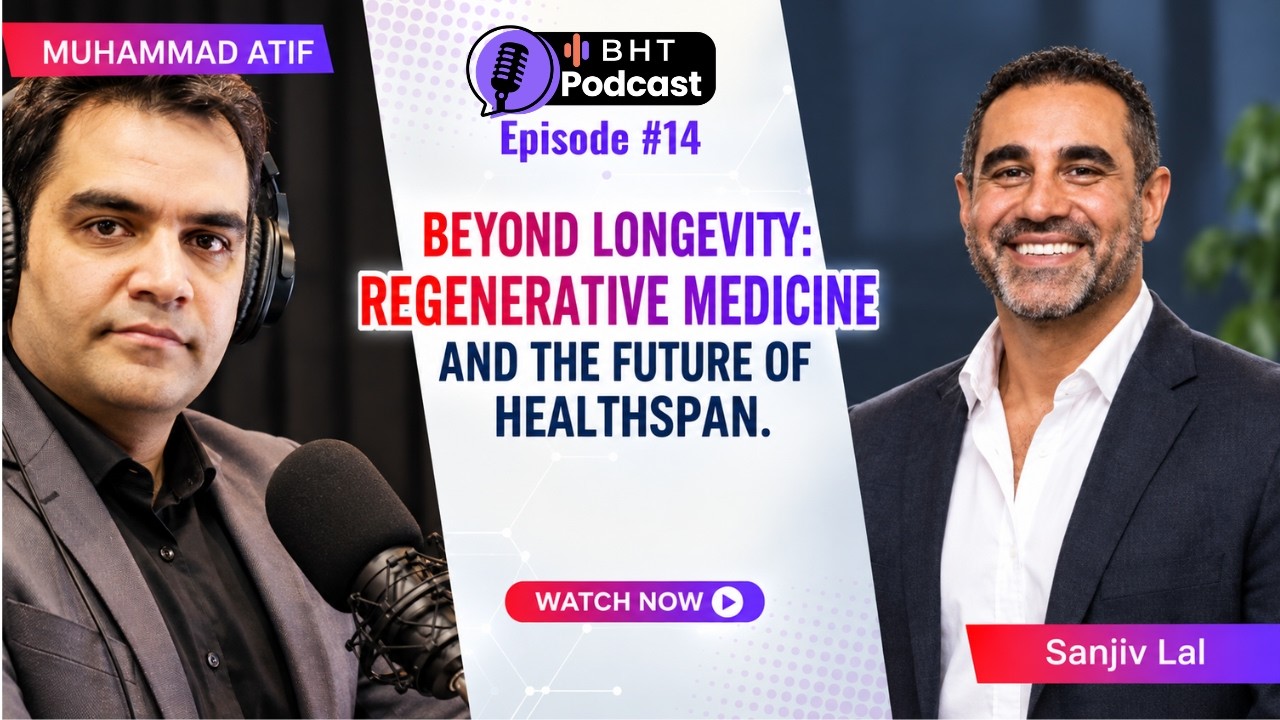
Beyond Longevity: Regenerative Medicine and the Future of Healthspan
From pharmacist to patient to founder: why living longer is not the same as living better.
Guest
Sanjiv Lal
Pharmacist & healthcare entrepreneur
Host
Muhammad Atif
CTO, PureLogics
Runtime
45 minutes
Video and audio

Watch the full conversation
Recorded for Better Health Tech. Also available on Spotify and wherever you listen.
Living longer is not the same as living better.
Sanjiv Lal studied pharmaceutical sciences at Ohio State, started his career as a pharmacist, worked with CVS and Eli Lilly, and opened a genetics laboratory in 2011. Then COVID put him in the ICU, and treatment left him with stage 3 kidney disease. Being the patient sent him down the path of regenerative medicine and cellular health.
In this episode he and Muhammad Atif talk through what that experience taught him: the difference between lifespan, healthspan and joy span, how cell signaling works, how to tell real science from longevity hype, and what has to change for regenerative medicine to become accessible and trusted.
What the episode covers
- From pharmacist at CVS and Eli Lilly to healthcare entrepreneur
- COVID, the ICU and a stage 3 kidney disease diagnosis
- What becoming a patient revealed about the healthcare system
- Lifespan, healthspan and joy span, and why they differ
- Cell signaling and the secretome, explained without the jargon
- Stem cells, peptides and secretome: how they are different
- The evidence patients should ask for before any treatment
- Where predictive, preventive and regenerative care is heading
Episode at a glance
Guest
Sanjiv Lal
Role
Pharmacist & healthcare entrepreneur
Host
Muhammad Atif, CTO, PureLogics
Series
Better Health Tech, episode 14
Topic
Longevity, regenerative medicine, healthspan
Runtime
About 45 minutes
Inside the episode
Chapter markers taken from the recorded episode.
Highlights and introduction
Health is the new wealth, and the conversation ahead.
From pharmacist to entrepreneur
Ohio State, Eli Lilly, biotech, and a genetics lab in 2011.
The turning point
Four days in the ICU with COVID, then a stage 3 kidney diagnosis.
Building Beverly Hills Rejuvenation Center
A US-made product and 22 centers converted to longevity care.
Becoming the patient
What the healthcare system looked like from the other side.
Lifespan, healthspan and joy span
Why more years are not automatically good years.
The science of cell signaling
How cells communicate, and what changes as we age.
Stem cells, peptides and secretome
Three terms everyone uses, and how they differ.
Evidence, hype and quality standards
What patients should ask a clinic before any treatment.
The future of healthcare
From internal medicine to longevity medicine, and who gets access.
Rapid-fire round
Four questions, one of them answered in a single word.
Six questions to ask before any regenerative treatment
The standards Sanjiv says should be non-negotiable, from the source material to the results you can measure.
Where does it come from?
Know the source material behind the product, not just the claims made about it.
How is it tested?
Sterility and endotoxin testing should be standard, with results you can see.
What is actually in it?
Protein and analytical characterization of what the product contains.
Where and how is it made?
Manufacturing standards, and spot testing for heavy metals and toxins.
How will results be measured?
A baseline, then lab or test results that show change, not only how you feel.
Is it science or a sales pitch?
Ask for the science behind the confident claims before you commit.
Sanjiv Lal, on Better Health Tech
Three things to take from this conversation
Healthspan is the real goal
Extra years spent managing chronic disease are not the same as healthy years. Sanjiv adds a third measure: joy span, the community and purpose that make those years worth living.
Fix root causes, not symptoms
Most care today is reactive and symptomatic. The shift Sanjiv describes is toward predictive, preventive care that keeps people healthy instead of only seeing them when they are sick.
Good science needs infrastructure
Longevity has promising science but weak infrastructure. Sourcing, testing, measurement and physician education are what make it trustworthy and accessible.
Sanjiv Lal
Pharmacist and healthcare entrepreneur
Sanjiv studied pharmaceutical sciences at Ohio State and began his career as a pharmacist, working with CVS and Eli Lilly before moving into biotechnology. In 2011 he opened a genetics laboratory focused on pharmacogenetics and an early stage of personalized medicine.
After COVID left him with stage 3 kidney disease, he turned to regenerative medicine and cellular health. His team now produces a secretome-based product in Oklahoma City, and acquired Beverly Hills Rejuvenation Center, converting its locations in California and Texas into longevity and regenerative aesthetics centers.
Muhammad Atif
Chief Technology Officer, PureLogics
Atif hosts Better Health Tech, where he talks to the people building healthcare technology about what actually ships and what actually gets used. At PureLogics he leads custom healthcare and enterprise engineering work.
His interest across the series runs through this episode too: separating what is proven from what is promising, and what it takes for new care to reach everyone.
Why this episode matters
Longevity is one of the loudest corners of healthcare right now, and one of the hardest to judge. This conversation comes from someone who has worked in pharma, diagnostics and regenerative medicine, and who has also been the patient. It gives founders, clinicians and patients a clearer way to ask what is proven, what is promising and what still needs better standards.
The rapid-fire round
Four questions at the end of the episode. Sanjiv answers the first in a single word.
- One thing you wish doctors were trained differently on?
- One longevity trend you think is nonsense?
- One habit you have changed since your diagnosis?
- One piece of advice for a healthcare founder?
Questions people ask about this episode
What is the difference between lifespan, healthspan and joy span?
In Sanjiv’s words, lifespan is how long you live, healthspan is how many of those years you spend healthy rather than managing chronic disease, and joy span is the community, friendship and purpose that make those years worth living.
What is the secretome?
The set of signals a cell releases to communicate with other cells. Sanjiv describes it as acellular and DNA-free, carrying the messages that tell cells how to repair and communicate.
How are stem cells, peptides and secretome different?
As Sanjiv explains it, peptides are short amino acid chains that send one specific signal, stem cells are live cells, and the secretome is the broad set of signals cells release, which he sees as where much of a stem cell’s effect comes from.
Is regenerative treatment a one-time thing?
Sanjiv says it is more than one treatment but not forever. The aim is to get the body back to a healthier state, then hold it there with the fundamentals: nutrition, diet and exercise.
What should patients ask a regenerative medicine clinic?
Where the product comes from, how it is tested and made, what is in it, and how results will be measured against a baseline. Confident claims are not the same as evidence.
Who should watch this episode?
Healthcare founders, clinicians and anyone trying to make sense of longevity and regenerative medicine, especially what is backed by science and what still needs better standards.
Building something in healthcare worth talking about?
Better Health Tech features the people shipping real healthcare technology. Tell us what you are building.