How AI Solves Delegation & Payment Errors in Healthcare Claims | Michael Riley (Gabeo.ai)
Inside the hidden financial leakage across health plans, IPAs and MSOs, and how AI agents catch it before cash leaves the door.
Guest
Michael Riley
Co-Founder & CPO, Gabeo.ai
Host
Muhammad Atif
President & CTO, PureLogics
Runtime
49 minutes
Video and audio

Watch the full conversation
Recorded for Better Health Tech. Also available on Spotify and wherever you listen.
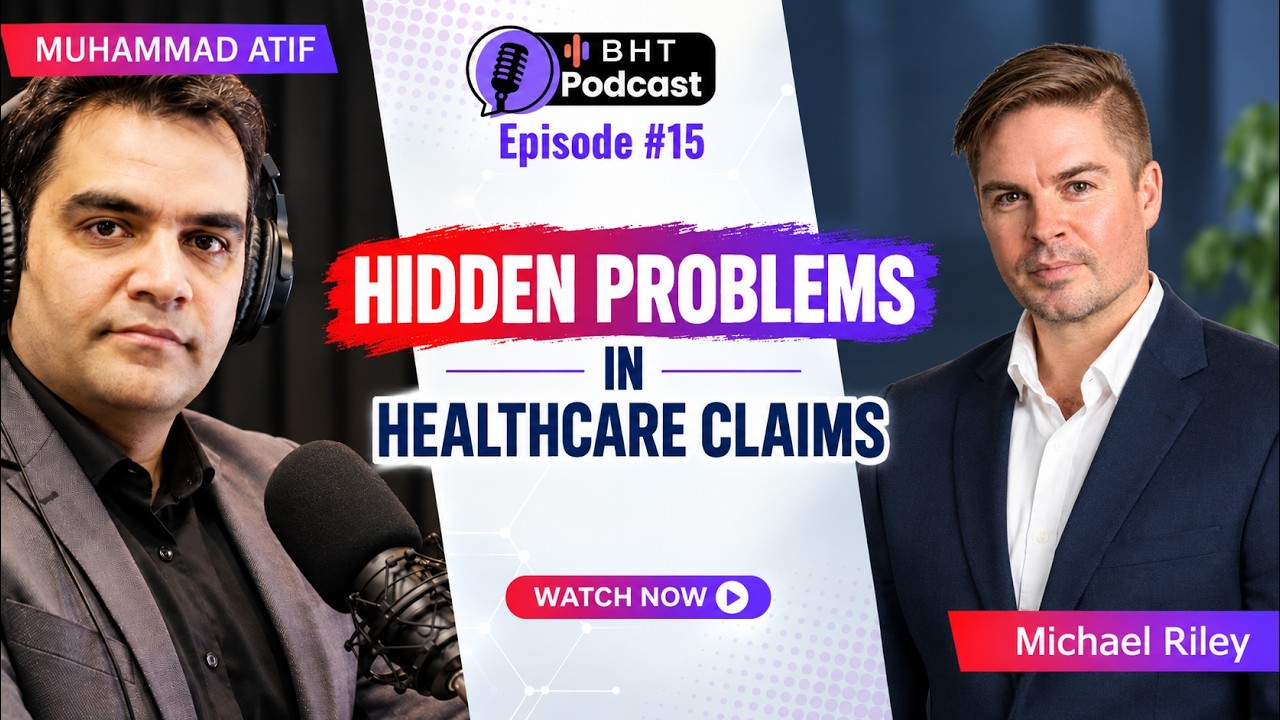
A claim can be approved, processed correctly and paid, and still be paid by the wrong organization.
In value-based care, financial responsibility for a single claim is split between health plans, IPAs and MSOs through delegation contracts. The document that decides who pays for what is the DOFR, the Division of Financial Responsibility. When that contract and the claims system disagree, money leaks quietly: claims paid by the wrong party, services paid twice, and errors nobody sees until an audit, if ever.
Michael Riley, Co-Founder and Chief Product Officer of Gabeo.ai, joins Muhammad Atif to explain why traditional claims software misses these errors, how AI agents can read complex contracts and check every claim against them, and why a human stays in the loop when a single decision can be worth millions.
What the episode covers
- How a claim gets paid correctly, but by the wrong party
- Double payments and where financial leakage hides
- What a DOFR is and why it breaks inside claims software
- Delegated risk between health plans, IPAs and MSOs
- How AI reads complex contracts and turns them into rules
- Catching payment errors before cash leaves the door
- Human-in-the-loop review for multi-million dollar decisions
- Denied claims versus incorrectly paid claims
Episode at a glance
Guest
Michael Riley
Role
Co-Founder & CPO, Gabeo.ai
Host
Muhammad Atif, President & CTO, PureLogics
Series
Better Health Tech, episode 13
Topic
Payment integrity, DOFR, AI agents for claims
Runtime
About 49 minutes
Inside the episode
Jump to any part of the conversation.
The healthcare payment mystery
How a correct, paid claim can still land on the wrong balance sheet.
Paid correctly, to the wrong party
How delegation means the right claim can be paid by the wrong organization.
The million-dollar question
Double payments and the financial leakage nobody is tracking.
Why DOFR contracts break in software
The gap between how contracts are written and how claims systems pay.
How AI reads complex contracts
Turning contract terms into rules and spotting payment errors claim by claim.
Human-in-the-loop
Preventing AI hallucinations when decisions are worth millions.
The founding story of Gabeo.ai
Why the team set out to fix payment integrity.
Rapid-fire Q&A
Denied versus incorrectly paid claims, and short answers to close.
Where the money leaks
Six places payment errors hide between the contract and the claims system, and what it takes to catch them before the money goes out.
Wrong-party payments
The claim is valid and paid correctly, but by the organization that was never financially responsible for it.
Double payments
The same service paid by both the health plan and the delegated group, because neither system sees the other.
DOFR drift
Contracts change, amendments stack up, and the rules configured in claims software fall behind.
Benefit and EOC mismatches
Payments that do not line up with the evidence of coverage or benefit grids they are supposed to follow.
Overpayments and underpayments
Line-level pricing errors that are small per claim and large across a year of volume.
Errors found too late
Problems discovered in a retrospective audit, after the cash has already left the door.
Better Health Tech, episode 13, with Michael Riley of Gabeo.ai
Three things to take into your next build
A paid claim is not a correct claim
Approval and payment only prove the claim was processed. Whether the right organization paid it depends on the delegation contract behind it.
Contracts have to become logic
A DOFR that lives in a PDF cannot be enforced by a claims system. Codifying it into versioned rules is what makes every claim auditable.
Keep a human in the loop
AI can check every claim against every contract, but decisions worth millions still need people to review and approve the rules and the findings.
Michael Riley
Co-Founder and Chief Product Officer, Gabeo.ai
Michael co-founded Gabeo.ai, which builds AI payment integrity software that audits claims against the contracts and policies that govern them. As Chief Product Officer he leads the product work behind that platform.
Gabeo works with health plans, IPAs and MSOs to codify delegated risk arrangements such as DOFRs into machine logic, and with providers to find recoverable denied and underpaid claims.
Muhammad Atif
President and Chief Technology Officer, PureLogics
Atif hosts Better Health Tech, where he talks to the people building healthcare technology about what actually ships and what actually gets used. At PureLogics he leads custom healthcare and enterprise engineering work.
His interest across the series runs through this episode too: the gap between how a system is supposed to work and what actually happens when real money and real contracts are involved.
Why this episode matters
Most healthcare AI conversations focus on clinical care. This one follows the money. If you run operations, finance or technology at a health plan, IPA or MSO, the gap between your contracts and your claims system is a cost you are probably already paying.
The rapid-fire round
The episode closes with a rapid-fire round on denied versus incorrectly paid claims.
- Denied claims or incorrectly paid claims: which costs more?
- Which is harder to detect?
- Where does financial leakage start?
- Can AI replace payment integrity teams?
- Real-time audit or retrospective audit?
- The biggest misconception about DOFRs?
- One thing health plans should fix first?
- One piece of advice for healthcare founders?
Questions people ask about this episode
What is a DOFR in healthcare?
A Division of Financial Responsibility is the part of a delegation contract that says which organization, the health plan, IPA or MSO, pays for each type of service.
How can a claim be paid correctly but by the wrong party?
The claim is valid and priced correctly, but under the DOFR another organization was responsible for it. The payment looks fine, so ordinary claims checks never flag it.
Why do traditional claims systems miss double payments?
The health plan and the delegated group often run separate systems. Neither sees the other’s payments, and contract rules are rarely fully configured in either.
How does AI help with payment integrity?
AI can read contracts, convert their terms into rules and check every claim against them, finding errors before payment instead of months later in an audit.
Why keep a human in the loop?
Large financial decisions need review. People approve the rules the AI builds and validate its findings, which guards against hallucinated or wrong conclusions.
Who should watch this episode?
Leaders in operations, finance, payment integrity and technology at health plans, IPAs, MSOs and provider groups working in delegated or value-based care.
Building something in healthcare worth talking about?
Better Health Tech features the people shipping real healthcare technology. Tell us what you are building.