Powering the Next Generation of AI Healthcare Devices
The future of edge AI and wearables, with the engineer who made chips run on almost nothing.
Guest
Dr. Scott Hanson
Founder & CTO, Ambiq
Host
Muhammad Atif
CTO, PureLogics
Runtime
35 minutes
Video and audio

Watch the full conversation
Recorded for Better Health Tech. Also available on Spotify and wherever you listen.
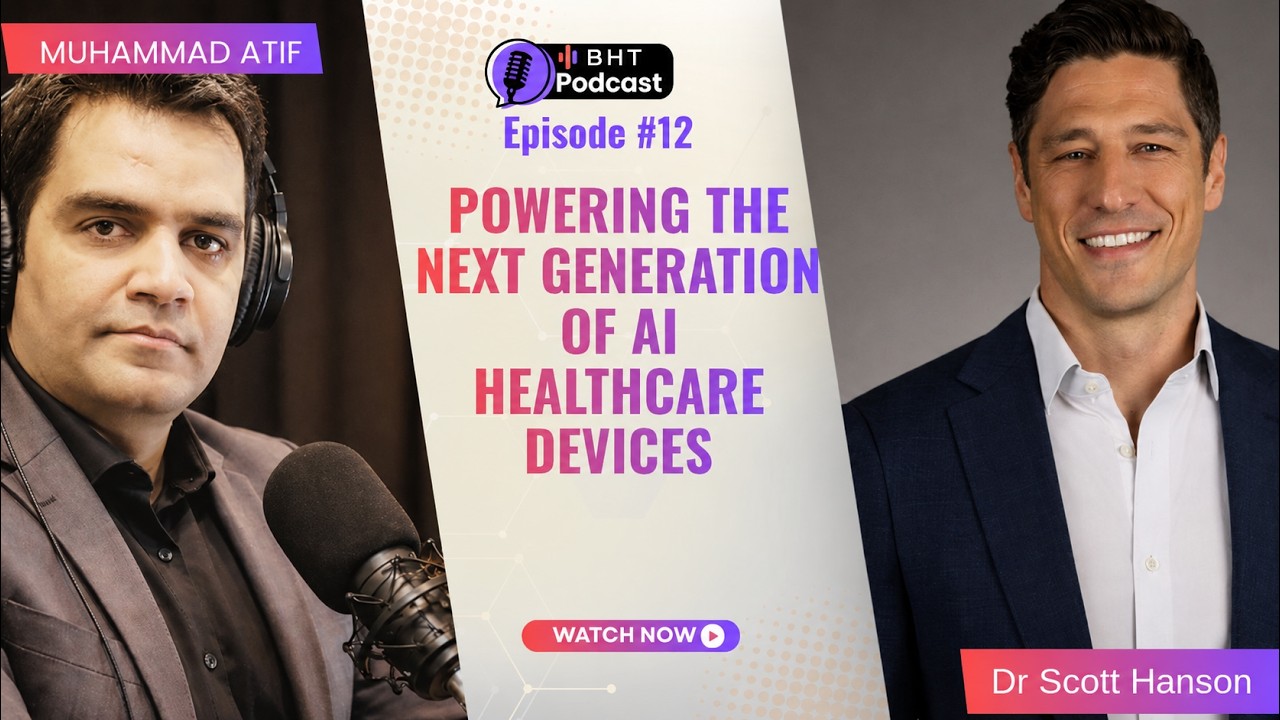
A wearable cannot wait for the cloud to tell someone they have fallen.
Scott Hanson started out designing circuits small and efficient enough to live inside medical implants. That research became SPOT, Sub-threshold Power Optimized Technology, and then Ambiq, whose Apollo processors now sit inside hundreds of millions of devices.
In this episode he and Muhammad Atif work through the question every connected-device team eventually hits: what should the sensor decide by itself, what belongs on the phone or gateway, and what should travel to the cloud. The answer changes battery life, privacy exposure, regulatory burden and, in the end, whether a patient keeps the device on.
What the episode covers
- Why edge AI matters when connectivity, latency and battery are all constrained
- What sub-threshold voltage actually changes for a medical device
- Splitting work across the sensor, a nearby phone or gateway, and the cloud
- Separating normal daily variation from a clinically meaningful change
- Battery life as a driver of adherence, not a spec-sheet line
- Small specialised models, NPUs, compression and quantisation
- Personal baselines per patient without an uncontrolled algorithm
- FDA expectations for real-world performance, security and clinical trust
Episode at a glance
Guest
Dr. Scott Hanson
Role
Founder & CTO, Ambiq
Host
Muhammad Atif, CTO, PureLogics
Series
Better Health Tech, episode 12
Topic
Edge AI, wearables, ultra-low-power silicon
Runtime
About 35 minutes
Inside the episode
Chapter markers follow the recording plan. Confirm them against the final cut before you paste them into the YouTube description.
Opening
Why intelligence on the device is the question behind healthcare AI.
From medical implants to Ambiq
The PhD problem that turned into SPOT and a company.
Why healthcare needs edge AI
Falls and arrhythmias do not wait for a good connection.
Turning data into clinical signal
More alerts is not better care. Which alert, and with what context.
Battery life and patient adoption
A device on the charger is a device collecting nothing.
Tiny models and local intelligence
Recognising one pattern well beats writing a long report.
Privacy, security and clinical trust
What the FDA now expects after launch, not just before it.
Looking ahead
What healthcare technology leaders should prepare for.
Rapid-fire round
Short answers, asked of a founder and CTO.
Already mature enough to run on the device
Six workloads Atif puts to Scott directly: which of these are ready for a wearable or medical device today, and what still belongs somewhere else.
ECG and arrhythmia detection
Continuous rhythm analysis on the wrist or patch, flagging events as they happen.
Fall detection
An event that has to be recognised locally, because the response cannot wait.
Sleep analysis
Overnight staging and disturbance patterns without shipping raw signal anywhere.
Respiratory monitoring
Rate and effort tracked through the day at a power budget a patch can carry.
Voice biomarkers
Speech-derived markers processed on device, where the audio never leaves.
Glucose pattern recognition
Trends and excursions interpreted close to the sensor, not after the fact.
Muhammad Atif, host of Better Health Tech and CTO at PureLogics
Three things to take into your next build
Architecture is a clinical decision
Where a computation runs decides latency, privacy exposure and what happens when the connection drops. Draw that line before you pick a model.
Power budget decides adherence
A wearable that needs charging every few hours stops being worn, and the data gap it leaves is a clinical gap, not an engineering one.
Trust is designed in, not bolted on
Cybersecurity, validation and regulatory work start with the architecture. Retrofitting them onto a shipped device is the expensive path.
Dr. Scott Hanson
Founder and Chief Technology Officer, Ambiq
Scott invented SPOT, Sub-threshold Power Optimized Technology, while completing his PhD at the University of Michigan, and founded Ambiq in 2010 to bring it to market. He led the development of the Apollo processor family, now used across wearables, hearables and connected medical devices.
He leads Ambiq’s technology roadmap, working on ultra-low-power computing, edge AI and the silicon that lets healthcare devices think without draining their battery.
Muhammad Atif
Chief Technology Officer, PureLogics
Atif hosts Better Health Tech, where he talks to the people building healthcare technology about what actually ships and what actually gets used. At PureLogics he leads custom healthcare and enterprise engineering work.
His interest across the series is the same one that runs through this episode: the gap between a promising system and one that survives contact with clinical workflow.
Why this episode matters
Most healthcare AI conversations stop at the model. This one goes underneath it, to the power budget, the silicon and the architecture decisions that determine whether a device is worn, trusted and cleared. If you build connected medical products, those decisions are yours to make early.
The rapid-fire round
Eight questions at the end of the episode. Scott answers all of them in under two minutes.
- Cloud AI or edge AI?
- Longer battery life or more computing power?
- The most underestimated healthcare application for edge AI?
- One emerging technology healthcare leaders should watch?
- One common misconception about AI hardware?
- One book you recommend to technology founders?
- One mistake first-time hardware founders should avoid?
- One healthcare device you wish already existed?
Questions people ask about this episode
What is edge AI in healthcare?
Running the analysis on the device that collects the signal, rather than sending raw data to a server first. A patch that recognises an arrhythmia itself is doing edge AI.
Does edge AI replace cloud AI?
No. The device handles what has to be immediate. The cloud handles longitudinal trends, deeper analysis and coordination with the rest of the health system.
What does sub-threshold operation mean?
Running transistors below their usual switching voltage, which cuts power draw dramatically. For a medical device it means more computation inside the same tiny battery.
Which health workloads run on-device today?
ECG and arrhythmia detection, fall detection, sleep analysis, respiratory monitoring, voice biomarkers and glucose pattern recognition are all discussed in the episode.
Why does battery life affect data quality?
Patients take off devices to charge them. Every charging window is missing data, and missing data is what breaks longitudinal clinical value.
Who should watch this episode?
Product and engineering leaders building connected medical devices, and anyone weighing an on-device versus cloud architecture for health data.
Building something in healthcare worth talking about?
Better Health Tech features the people shipping real healthcare technology. Tell us what you are building.